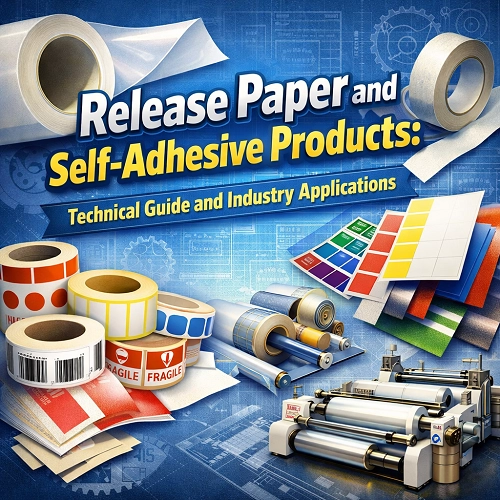
Release Paper and Self-Adhesive Products: Technical Guide and Industry Applications
Figure 1: Integration of release paper and self-adhesive materials in label production
Introduction: Understanding Release Paper and Self-Adhesive Materials
In the modern manufacturing landscape, release paper and self-adhesive materials represent two critical components in the production of labels, decals, and other pressure-sensitive applications. These materials work in tandem to create functional, reliable products across diverse industries including packaging, logistics, pharmaceuticals, and consumer goods.
Release paper, also known as silicone-coated release liner, serves as a carrier substrate that temporarily holds adhesive material and can be easily separated without damaging the underlying label. Meanwhile, self-adhesive materials provide the necessary tackiness and bonding capability to ensure products adhere properly to various surfaces while maintaining product integrity during application and use.
TGX Group specializes in premium release paper solutions engineered to meet stringent industry requirements, combining decades of expertise with advanced manufacturing technology to deliver exceptional performance across global markets.
What Is Release Paper? Technical Definition and Function
Release paper is a coated substrate designed to release pressure-sensitive adhesive products without tearing, delamination, or residual stickiness. The release properties come primarily from silicone coating applied to the paper's surface, creating a non-adhesive barrier that allows clean separation of the label from its backing.
Figure 2: Typical multi-layer composition of release paper used in self-adhesive applications
Key Characteristics of Release Paper
- Silicone Coating: The defining feature that enables clean, consistent release without adhesive residue. Coating levels typically range from 0.5 to 2.0 micrometers.
- Release Force: Measured in grams per inch (g/in), this specification determines how easily the adhesive label separates from the paper backing.
- Tensile Strength: Critical for handling during converting processes, typically ranging from 1,500 to 3,000 psi depending on paper grade.
- Moisture Resistance: Essential for stability during storage and in varying humidity conditions, maintaining dimensional consistency.
- Chemical Resistance: Protection against oils, solvents, and other substances that may contact the paper during application or storage.
Standard Release Paper Specifications
| Property | Typical Range | Test Method |
|---|---|---|
| Release Force (Light) | 25-50 g/in | ASTM D6195 |
| Release Force (Medium) | 50-100 g/in | ASTM D6195 |
| Release Force (Heavy) | 100-200+ g/in | ASTM D6195 |
| Tensile Strength | 1,500-3,000 psi | ASTM D882 |
| Elongation at Break | 2-5% | ASTM D882 |
| Paper Basis Weight | 40-80 gsm | ISO 536 |
Self-Adhesive Materials: Composition and Performance
Self-adhesive materials represent a sophisticated combination of substrate, adhesive, and backing components engineered to maintain consistent bonding performance across diverse applications and environmental conditions.
The Four-Layer Structure of Self-Adhesive Label Stock
Professional self-adhesive materials consist of a carefully balanced multi-layer system designed to optimize performance:
Figure 3: Complete layer structure of premium self-adhesive label stock
Adhesive Type Comparison
Different adhesive systems serve specific applications based on environmental conditions, substrate compatibility, and removal requirements:
| Adhesive Type | Temperature Range | Primary Applications | Key Advantages |
|---|---|---|---|
| Natural Rubber-Based | -20°C to 60°C | Food packaging, shipping labels | Immediate tack, cost-effective |
| Synthetic Rubber | -30°C to 70°C | Industrial, chemical resistant applications | Better chemical resistance |
| Acrylic | -40°C to 100°C | Outdoor labels, long-term applications | UV resistance, temperature stability |
| Hot-Melt | -20°C to 80°C | Carton sealing, temporary labeling | Rapid setting, removable options |
Technical Issues in Release Paper and Self-Adhesive Products
While release paper and self-adhesive materials are highly engineered products, manufacturers and users frequently encounter technical challenges that require careful management and specialized knowledge.
Common Technical Problems and Solutions
1. Adhesive Transfer (Ooze or Bleed-Out)
Problem: Adhesive migrates from the label face onto the release liner, creating a tacky, contaminated backing that prevents clean separation and complicates the converting process.
Causes: Excessive adhesive application, inadequate release coating, elevated storage temperatures, or incompatibility between release coating and adhesive chemistry.
Solutions: Optimize adhesive coating weight, verify release force specifications match adhesive chemistry, implement proper climate-controlled storage (70-75°F, 45-55% RH), and conduct compatibility testing before large-scale production runs.
2. Curl and Dimensional Instability
Problem: Labels exhibit curl or warp, preventing proper application and creating appearance defects.
Causes: Moisture absorption differentials between layers, improper storage in high-humidity environments, or excessive temperature fluctuations causing differential expansion and contraction.
Solutions: Maintain storage conditions at 50% relative humidity and 70°F, use calendering equipment to reduce thickness variations, specify higher-quality base papers with better dimensional stability, and implement acclimatization periods before processing.
3. Release Force Degradation
Problem: Release properties deteriorate over time, causing difficulty in separating labels from backings or increased paper tear during application.
Causes: Silicone coating oxidation, contamination from environmental pollutants, or reaction with specific adhesive chemistries under prolonged storage.
Solutions: Specify UV-stabilized silicone coatings, maintain optimal storage conditions away from direct sunlight and extreme temperatures, rotate inventory using FIFO (first-in, first-out) principles, and conduct periodic release force testing on stored materials.
4. Die-Cutting Issues and Edge Chipping
Problem: During die-cutting operations, paper fibers separate at label edges, creating rough, unsealed edges that compromise durability and appearance.
Causes: Insufficient paper density, excessive adhesive softening blade edges, dulled cutting implements, or improper blade clearance settings.
Solutions: Use higher-quality paper substrates with better wet-strength properties, sharpen or replace cutting blades regularly (typically every 5-10 million cuts), maintain optimal blade clearance (0.002-0.005 inches), and implement regular equipment maintenance schedules.
5. Application Speed and Label Placement Accuracy
Problem: High-speed label applicators experience jamming, misalignment, or label bunching, reducing line efficiency.
Causes: Excessive static electricity, inconsistent release force values within rolls, inadequate tension control, or moisture-induced dimensional variation.
Solutions: Install static elimination bars at label feed points, verify tighter release force tolerances (±5 g/in), implement tension control systems with feedback mechanisms, maintain consistent humidity in production facilities, and conduct test runs at target application speeds before full production.
6. Adhesive Residue After Label Removal
Problem: Adhesive remains on the substrate after label removal, creating residue that requires cleaning or can damage surfaces.
Causes: Over-application of adhesive, inadequate release coating, or adhesive formulation incompatible with the release chemistry.
Solutions: Optimize adhesive weight specifications, conduct adhesive compatibility testing with specific release coatings, specify "clean-removable" adhesive formulations when required, and validate removal processes with actual substrate materials before deployment.
Manufacturing and Processing Considerations
The production of release paper and self-adhesive materials involves sophisticated manufacturing processes requiring precise control and advanced equipment.
Release Paper Manufacturing Process
- Paper Production: Base paper is manufactured from virgin or recycled fiber, meeting specified brightness, smoothness, and strength requirements.
- Coating Application: Silicone release agent is applied through roll-coating or spray-coating methods, followed by curing to cross-link the coating with paper fibers.
- Curing and Cross-linking: Heat treatment (typically 120-180°C) develops proper release characteristics and coating durability.
- Quality Testing: Release force, tensile strength, and dimensional stability are tested according to international standards (ASTM, ISO).
- Slitting and Conversion: Large parent rolls are slit to customer-specified widths and core diameters for practical handling.
Figure 4: Typical release paper manufacturing process flow with key operational parameters
Self-Adhesive Converting Process
Converting release paper into finished self-adhesive label stock involves several precision operations:
- Adhesive Lamination: Pre-formulated adhesive is applied to the face stock substrate using precise coating techniques (gravure, slot-die, or curtain coating).
- Release Liner Lamination: Release-coated paper is laminated to the adhesive layer using controlled pressure and temperature.
- Drying and Curing: The laminated material passes through drying tunnels to remove solvents and allow full adhesive development.
- Die-Cutting: Material is cut into specified label shapes using precision die-cutting equipment.
- Quality Assurance: Labels are inspected for dimensional accuracy, adhesive consistency, and appearance defects.
Industry Applications and Market Segments
Release paper and self-adhesive materials serve critical functions across numerous industries, each with specific performance requirements and regulatory compliance needs.
Primary Applications by Industry
- Food & Beverage Packaging: Nutritional labels, ingredient declarations, and product identification requiring food-safety compliance and moisture resistance.
- Pharmaceutical & Healthcare: Medical device labeling, prescription information, and safety labels requiring pharmaceutical compliance and sterility.
- Logistics & Shipping: Barcode labels, tracking information, and shipping labels requiring high durability and readability through multiple handling cycles.
- Retail & Consumer Products: Price tickets, product identification, and promotional labels for department stores and retailers.
- Industrial & Manufacturing: Equipment labeling, safety warnings, and identification marking for industrial equipment and machinery.
- Automotive & Electronics: Component identification, warning labels, and traceability marking for high-temperature and chemical-resistant applications.
Regulatory Compliance and Certifications
Different applications require adherence to specific standards and certifications:
- FDA Compliance (CFR 175.104, 175.105): Food contact materials must meet FDA regulations regarding indirect food additives.
- ISO 12631: Guidelines for self-adhesive label durability testing and performance specifications.
- ASTM D6195: Standard test method for peel adhesion of pressure-sensitive tape and labels.
- FINAT Guidelines: European association standards for functionality of release coatings and pressure-sensitive label stock.
- Recyclability Standards: European Directive 94/62/EC requirements for packaging and label materials sustainability.
Innovation and Future Trends in Release Paper and Self-Adhesive Products
The industry continues to evolve with technological advances addressing sustainability, performance, and emerging application requirements.
Emerging Technologies
- Sustainable Release Coatings: Water-based and solvent-free silicone alternatives reducing environmental impact while maintaining performance characteristics.
- Specialty Adhesives: Temperature-resistant, repositionable, and removable adhesive formulations for specialized applications requiring non-permanent or reversible bonding.
- Digital-Ready Substrates: Face stocks optimized for digital printing technologies, enabling cost-effective short-run and personalized label production.
- Biodegradable and Compostable Options: Development of eco-friendly release papers and adhesive systems meeting circular economy requirements.
- Smart Labeling Solutions: Integration of RFID, NFC, and thermochromic technologies with self-adhesive substrates for enhanced functionality.
Figure 5: Market growth distribution across emerging technology segments
TGX Group: Advanced Solutions for Release Paper and Self-Adhesive Materials
TGX Group combines over 20 years of specialized expertise in release paper and self-adhesive material production with state-of-the-art manufacturing facilities and technology. Our comprehensive product portfolio addresses diverse industry requirements with precision-engineered solutions.
Manufacturing Excellence
Our 14,000 m² manufacturing facility includes:
- Advanced Supercalender Equipment: Precision calendering for optimal thickness control and surface smoothness (0.05mm tolerance).
- Multi-Station Coating Systems: Roll-coating and spray-coating capabilities for uniform silicone release application (0.5-2.0 µm coating thickness).
- Automated Slitting Equipment: High-precision slitting with core diameters from 76mm to 305mm, width tolerances ±1mm.
- Comprehensive Quality Control Laboratory: In-process and finished product testing for release force, tensile strength, moisture content, and dimensional stability.
Technical Support and Customization
Beyond standard product offerings, TGX Group provides:
- Custom formulation development for specialized adhesive and release coating requirements
- Technical consulting for converting process optimization and troubleshooting
- Sustainability assessments and eco-friendly material alternatives
- Prototype development and pilot production for new product evaluation
- Regulatory compliance documentation for FDA, FINAT, and international standards
Quality Assurance Commitment
TGX Group maintains rigorous quality control protocols throughout manufacturing:
- ISO 9001:2015 certification ensuring consistent quality management
- Regular third-party audits and compliance verification
- Real-time monitoring of critical manufacturing parameters
- Accelerated aging testing to validate long-term performance stability
Optimize Your Label Production with Premium Release Paper and Self-Adhesive Solutions
Whether you require standard release paper specifications or custom-engineered self-adhesive materials, TGX Group delivers exceptional quality, technical expertise, and reliable supply chain support. Our solutions have enabled manufacturers worldwide to enhance production efficiency, reduce waste, and improve product quality.
Contact Our Technical TeamConclusion
Release paper and self-adhesive materials represent critical components in modern label production, requiring precise engineering, quality manufacturing, and continuous technical support. Understanding the technical specifications, manufacturing processes, and common challenges enables manufacturers to optimize production efficiency, improve product quality, and meet evolving market demands.
The industry continues to evolve with emerging technologies addressing sustainability, performance, and specialized application requirements. Manufacturers who invest in understanding these materials and partner with experienced suppliers gain significant competitive advantages in product quality, production efficiency, and customer satisfaction.
TGX Group's combination of technical expertise, advanced manufacturing capabilities, and commitment to quality positions us as a trusted partner for organizations seeking premium release paper and self-adhesive solutions. Our comprehensive product portfolio, custom development capabilities, and technical support enable customers to navigate complex application requirements and achieve consistent manufacturing excellence.
For organizations seeking to enhance their label production capabilities or addressing specific technical challenges, TGX Group's technical team stands ready to provide expert guidance, customized solutions, and reliable long-term partnership.